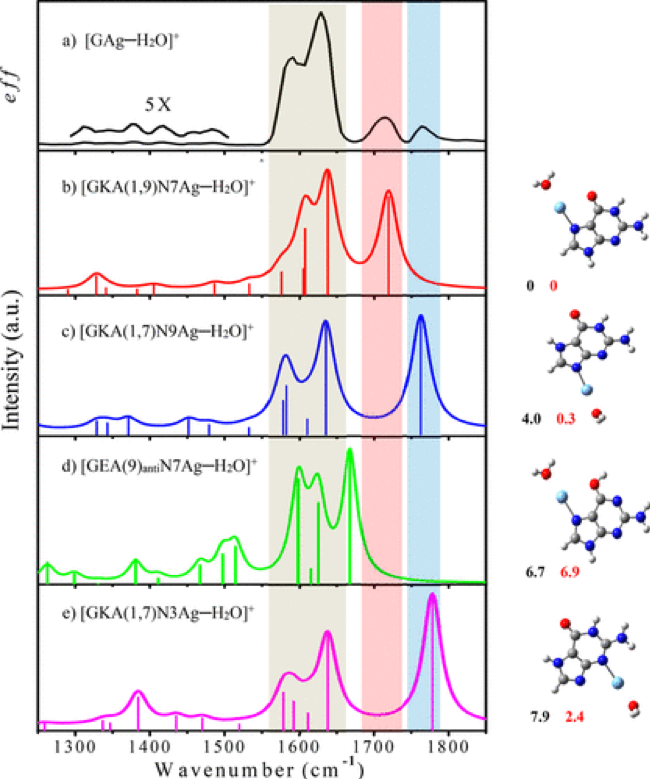
The characterization of the structure of guanine tautomers in the gas phase carried out by FT-ICR on the Orsay mass spectrometry platform in collaboration with the University of Cordoba in Argentina provides a better understanding of the recognition mechanisms between the different bases. DNA and RNA.
How can we improve our ability to analyze fatty acid-based biomolecules and nanomaterials? Is it possible to directly probe the vicinity of oxygen atoms? CNRS researchers from Montpellier have just shown that thanks to a new route of isotopic enrichment in 17O/18O, very high resolution analyzes by solid-state NMR and FT-ICR are now possible!
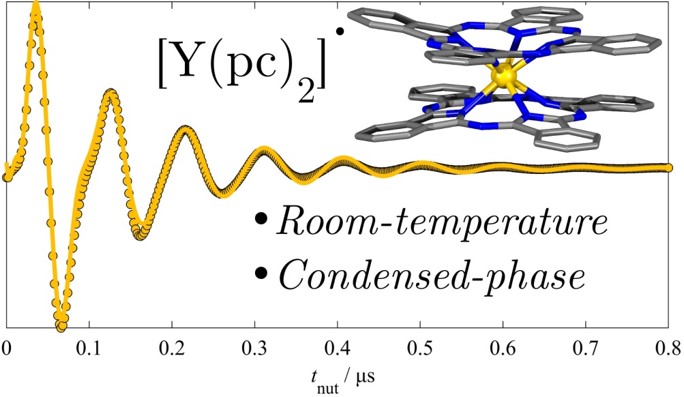
The Strasbourg EPR site uses several pulsed EPR sequences to study spin dynamics in the family of [Y(pc)2]• complexes. Non-deuterated compounds, the condensed magnetic phase and room temperature are the favorable conditions to highlight Rabi-type oscillations in these radical systems.
The RPE Lille site has identified the radical species responsible for the catalytic decomposition of organic molecules present in wastewater. With a cobalt catalyst and in the presence of an oxidizing molecule, the organic molecules are decomposed in less than 10 minutes.
By characterizing the interaction between fragments of BRCA2 and HSF2BP by NMR, SAXS and in vitro crystallography, as well as by immunoprecipitation in cells, teams from I2BC and ERASMUS MC identify the precise motif of BRCA2 at the origin of the very strong affinity between the two partners and shows that, in vivo, this complex has no function in the recruitment of Rad51 to the meiotic sites of homologous recombination.
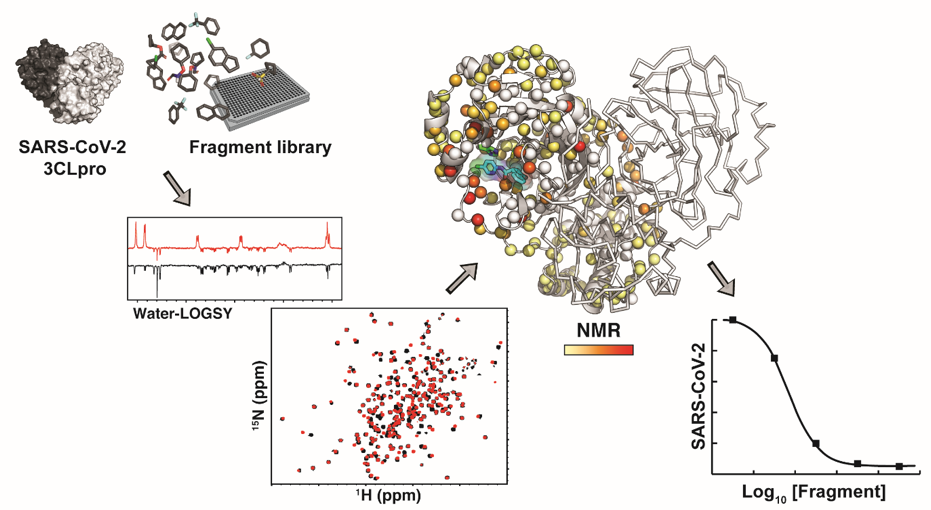
For the first time, an analysis by liquid NMR spectroscopy of the SARS-CoV-2 dimeric protease (3CLp) has been carried out, by the Lille NMR sites. This study determined that the F01 fragment is a protase inhibitor with antiviral activity in infected cells.
The team at the RMN site in Paris has developed a new method, based on relaxometry, to detect the interactions of small molecules with macromolecules in complex mixtures. In blood serum, this method identifies low affinity interactions between metabolites and proteins.
We respect your privacy and process your personal data in accordance with the GDPR. We use cookies to improve our site and for your convenience. More information.